The useful result
Explain one concept in your own words, find at least two gaps and confirm the corrected answers in your course material.
- Explain one concept in your own words, find at least two gaps and confirm the corrected answers in your course material.
Reading an AI explanation feels like learning, but recall is what builds memory. In this lesson you do the explaining. The AI listens, asks questions about gaps, and you check its feedback against your own course material.
It suits students and self-learners on any subject. Treat the AI as a study partner, not as the source of truth.
Reviewed on 10 October 2026. Expected outputs here are illustrative rather than captured AI runs. Account features, limits and wording can differ; keep your original inputs and verify the result before using it.
Before you start
- One topic from a course or book you are studying
- Your notes or textbook open for checking
Review evidence
Documentation-based review · 2026-10-10
Sources checked on the review date; exercise prompts and expected outputs are original illustrative teaching material.
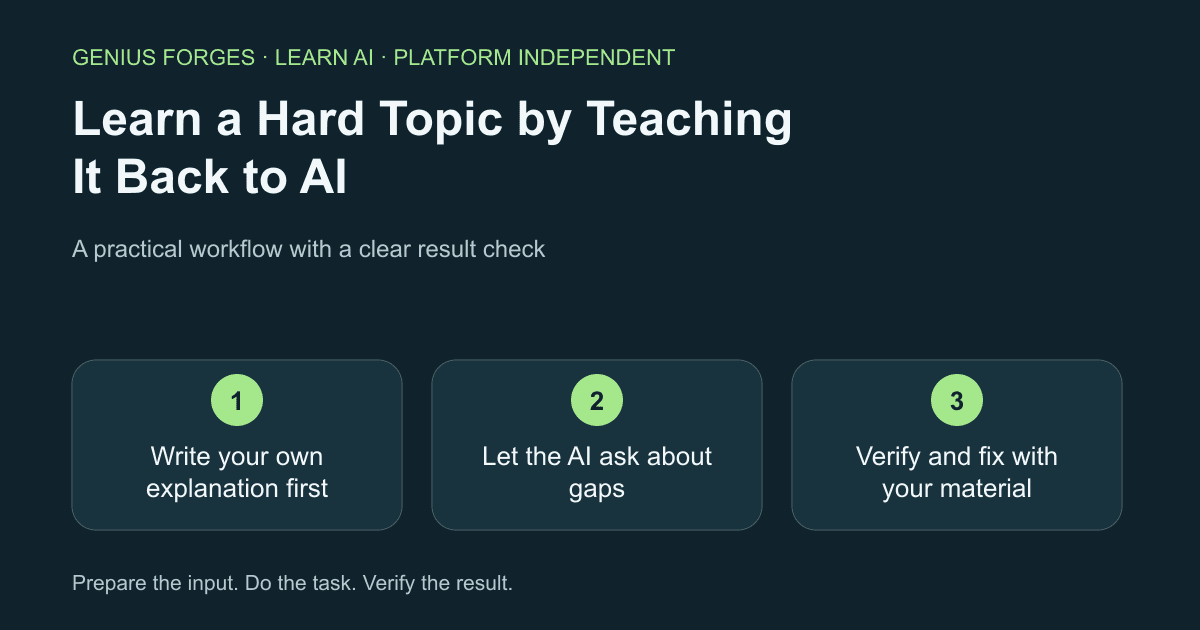
Write your own explanation first
Close your notes and explain the concept in a paragraph as if to a friend. Do not look things up. Missing pieces will show you where to focus.
Example / expected result
Illustrative example (not a recorded model result): Illustrative explanation: "Photosynthesis makes sugar from light, but I cannot remember where the oxygen comes from."
Check your result
You wrote the explanation from memory, with the gaps left visible.
Let the AI ask about gaps
Paste your explanation and tell the AI to act as a curious student. It should ask up to three questions about unclear or missing parts and must not give the answers yet. Try answering each one yourself.
Act as a curious beginner. Below is my explanation of [topic]. Ask up to three questions about parts that are unclear, missing or possibly wrong. Do not give answers or corrections yet.

[your explanation]
Example / expected result
Illustrative example (not a recorded model result): Question: "Where does the oxygen come from, water or carbon dioxide?"
Check your result
You can state which questions you answered confidently and which you could not.
Verify and fix with your material
Look up each unanswered or doubtful point in your textbook, lecture notes or an official source. Write the corrected version in your own words. Then ask the AI to quiz you on only those points, and check its answers again against the material.
Quiz me one question at a time on only these corrected points. Wait for my answer before replying.

[corrected points]
Check your result
Every correction is supported by a page or note you can cite.
When it goes wrong
AI can agree with a wrong explanation or add a wrong correction, so the textbook is the judge. Do not ask it to write your assignment; follow your institution's AI rules. If your questions come back too easy, ask for harder ones about edge cases.
Make it your own
Choose one concept from this week. Complete all three steps, then repeat the teach-back two days later without notes and compare.
Useful next resources
Sources and review
Last checked Oct 10, 2026. Features and account limits can change. Verify important results against your original material.
Did this help you complete your task?
Tell us what needs improving. No account or private output required.
Report incorrect information or a broken linkGenius Forges Editorial
Practical, documentation-reviewed AI exercises with explicit examples and independent result checks. Examples are illustrative unless a live test is explicitly documented.


